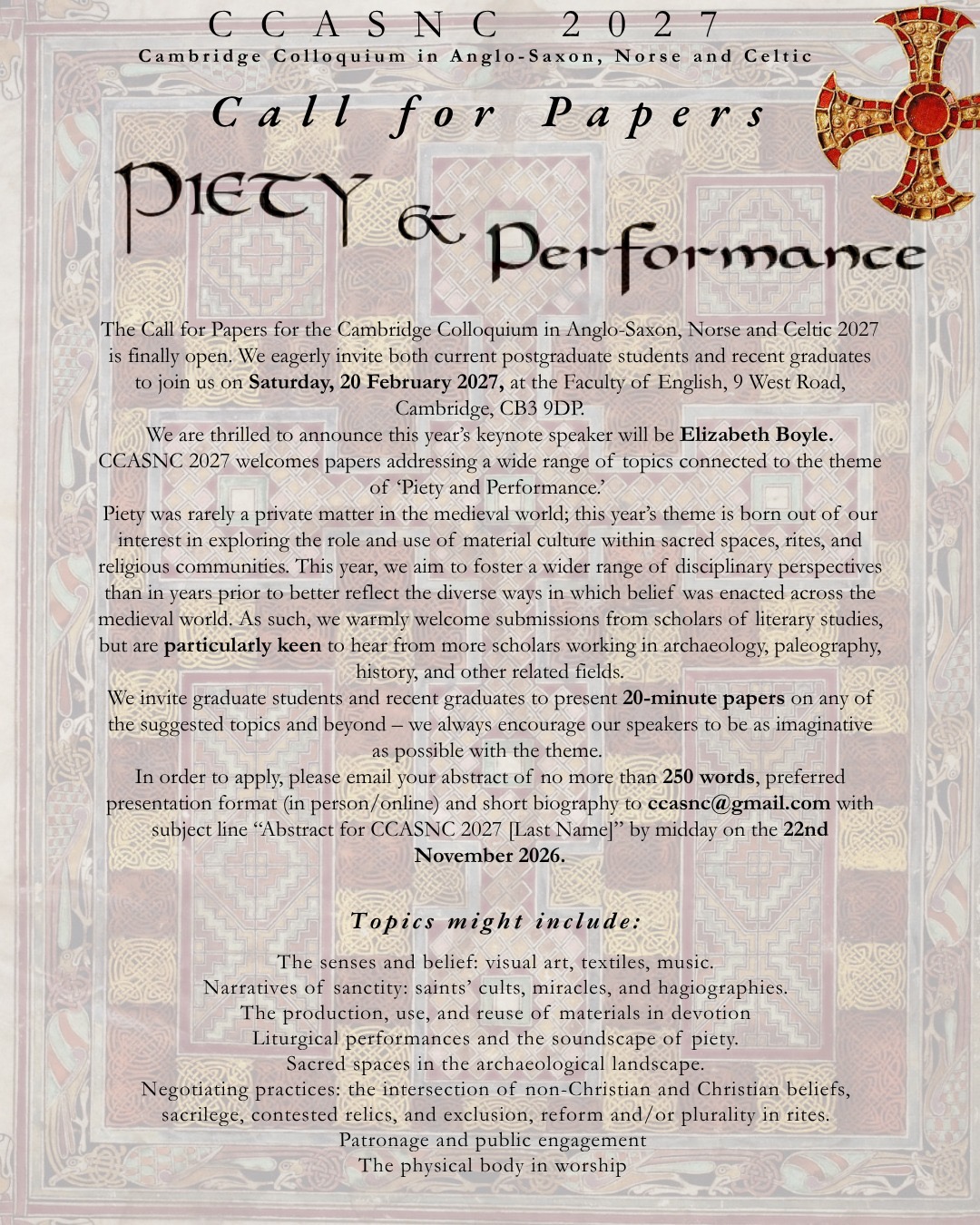
Cambridge Colloquium in Anglo-Saxon, Norse and Celtic

The Cambridge Colloquium in Anglo-Saxon, Norse and Celtic is now open to abstract submissions from current postgraduates or those who have recently completed postgraduate study for our 2027 conference on the theme ‘Piety and Performance’.  We are thrilled to announce that this year’s keynote speaker will be Dr Elizabeth Boyle (Maynooth).

Please submit your abstract of no more than 250 words, and a short biography to ccasnc@gmail.com with the subject line ‘Abstract for CCASNC [Lastname]’ by midday on the 22nd of November 2026.  The conference will take place on the 20th of February 2027.

New Directions in the History of Liturgy III

The Institute of Historical Research’s History of Liturgy seminar is pleased to announce that its successful New Directions study day will return in 2027, on Saturday 1 May, 10-5pm.

Venue: Faculty of English, West Road, Cambridge.

* * *

Proposals are sought for 5-minute lightning presentations (max. 3 powerpoint slides) on new research in the history of liturgy. The organisers are keen to hear from scholars from across the disciplines whose research engages with histories of communal religious worship, whether by means of its texts, spaces, rituals, meanings, or material traces.

Although the seminar’s primary focus is on liturgical traditions of medieval and early modern Western Europe, we warmly encourage proposals from researchers who engage with other chronologies, geographies or religious traditions, and/or the interfaces between them. Individuals who are well-advanced in their doctoral research or are at early career stage are particularly encouraged to apply.

Abstracts (150-200 words) and a brief biography (50 words), should be addressed to historyofliturgystudyday@gmail.com by Friday 26 February 2027.

* * *

All are welcome. Registration is free of charge, but pre-booking is required via https://www.history.ac.uk/seminars/history-liturgy. Attendees are responsible for funding their own transport and accommodation costs.

Organising committee: Helen Gittos (Oxford), Sarah Hamilton (Exeter), Erik Niblaeus (Cambridge), Henry Parkes (Nottingham), Tessa Webber (Cambridge).

* * *

The History of Liturgy seminar acknowledges the support of the Institute of Historical Research and the Henry Bradshaw Society.
New Directions in the History of Liturgy II (25 April 2026): Programme

The IHR History of Liturgy Seminar is pleased to announce details of its 2026 Study Day, New Directions in the History of Liturgy II, to take place in Cambridge on Saturday 25 April 2026, 10am-4.30pm.

Registration: https://www.history.ac.uk/news-events/seminars/history-liturgy

Programme: Downloadable programme

Directions: Faculty of English, Room GR 06/07, 9 West Road, Cambridge, CB3 9DP (https://what3words.com/valley.gold.causes)

Organised with support from the Institute for Historical Research and the Henry Bradshaw Society

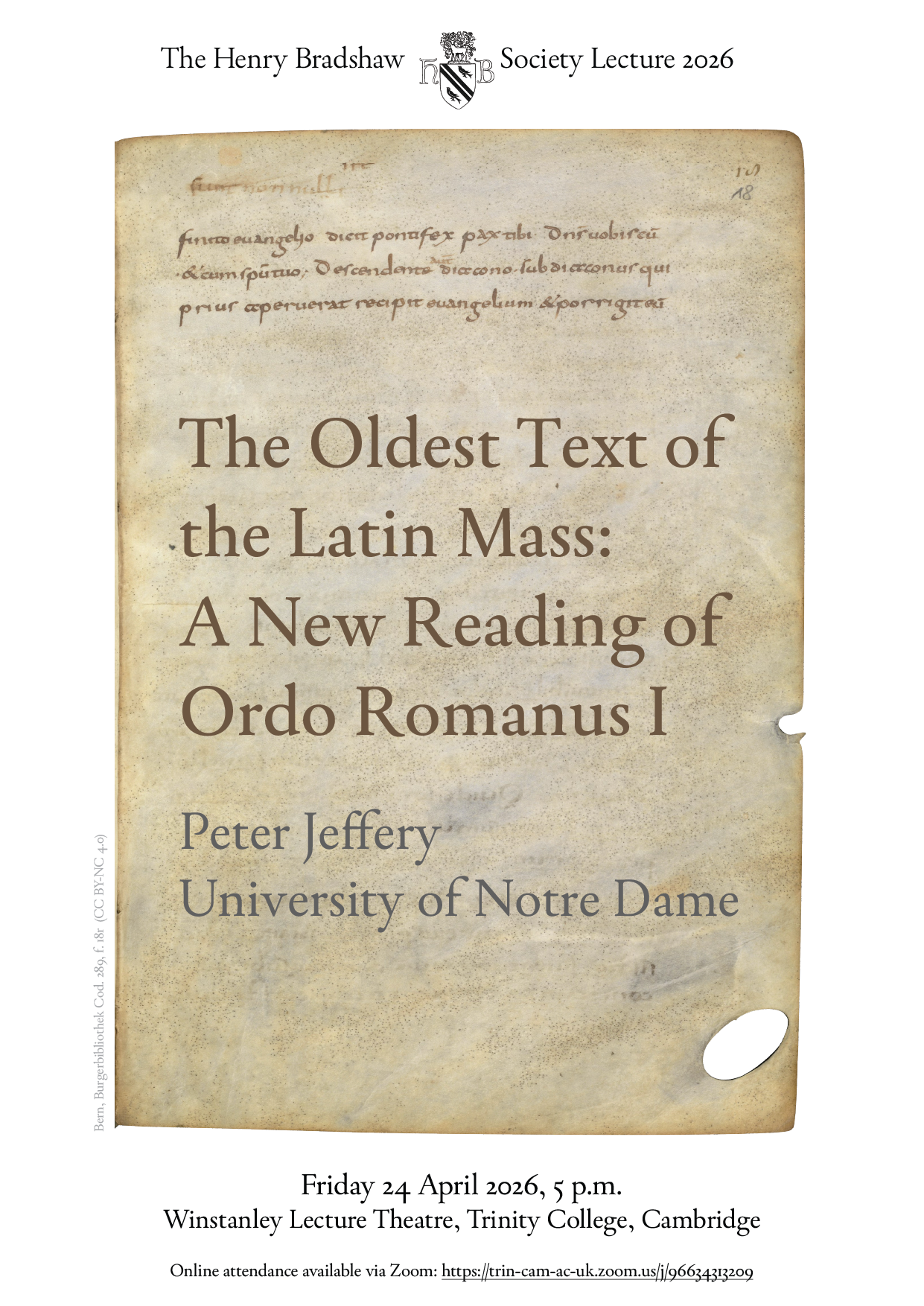
The Henry Bradshaw Society Lecture 2026

Friday 24 April 2026 at 5 p.m.
Winstanley Lecture Theatre, Trinity College, Cambridge

The Oldest Text of the Latin Mass: A New Reading of Ordo Romanus I
Peter Jeffery, University of Notre Dame

Ordo Romanus I deserves to be better known as a source for the political and religious history of medieval Europe. The wording changed significantly while the text was in circulation between the 8th and 12th centuries. A new theory about the origins of the text poses the question: what is the best way to present this “living literature” in a modern critical edition?

Zoom attendance possible via the link in the poster.

* * *

* * *

2026 HBS Annual Lecture – PNG poster

2026 HBS Annual Lecture – PDF poster

CFP: New Directions in the History of Liturgy II (25 April 2026)

CALL FOR PAPERS: New Directions in the History of Liturgy II (Deadline 30 March 2026)

Faculty of English, West Road, Cambridge, Saturday 25 April 2026, 10am-5pm    

* * *

Proposals are sought for 5-minute lightning presentations (max. 3 powerpoint slides) on new research in the history of liturgy, as part of a study day organised by the Institute of Historical Research’s History of Liturgy seminar. The organisers are keen to hear from scholars from across the disciplines whose research engages with histories of communal religious worship, whether by means of its texts, spaces, rituals, meanings, or material traces.

Although the seminar’s primary focus is on liturgical traditions of medieval and early modern Western Europe, we warmly encourage proposals from researchers who engage with other chronologies, geographies or religious traditions, and/or the interfaces between them. Individuals who are well-advanced in their doctoral research or are at early career stage are particularly encouraged to apply.

* * *

All are welcome. Registration is free of charge, but pre-booking is required via https://www.history.ac.uk/seminars/history-liturgy. Attendees are responsible for funding their own transport and accommodation costs.

Abstracts (150-200 words) and a brief biography (50 words), should be addressed to historyofliturgystudyday@gmail.com by Monday 30 March 2026.

Organising committee: Helen Gittos (Oxford), Sarah Hamilton (Exeter), Erik Niblaeus (Cambridge), Henry Parkes (Nottingham), Tessa Webber (Cambridge).

* * *

The History of Liturgy seminar acknowledges the support of the Institute of Historical Research and the Henry Bradshaw Society.
Medieval Worship and the Cult of St Cuthbert at Worksop (31 August–1 September 2024)

This research and public history event will take place at Worksop Priory, Nottinghamshire on Saturday 31 August and 1 September 2024. It is organised by the Music in the Shadows project at the University of Nottingham, supported by a grant from the AHRC.

All welcome, no registration required

Flyer for event at Worksop 31 August 2024

PROVISIONAL PROGRAMME:

Saturday 31 August 2024, 10am-5pm
Public history talks, open rehearsal, family activities

Sunday 1 September 2024, 5am-7am
Medieval night liturgy for the Feast of St Cuthbert

For more information email worksop.discovery.day@gmail.com or visit https://tinyurl.com/nightoffice

Study Day: New Directions in the History of Liturgy (18 May 2024)

Institute of Historical Research, History of Liturgy Seminar
Study Day: New Directions in the History of Liturgy

Saturday 18 May, 10am-5pm

Bloomsbury Room, G35, Ground Floor, 
Senate House, Malet Street, London WC1E 7HU

9.45am Arrival

10am 
NARRATIVES IN AND OF THE MEDIEVAL OFFICE I  
Chair: Henry Parkes (University of Nottingham)

  • Teresa Webber (University of Cambridge), ‘Narrative and the Annual Cycle of Biblical Reading in the Night Office’
  • Margot Fassler (University of Notre Dame), ‘The Timescape of the Purification Office in Twelfth and Thirteenth-Century Paris’
  • Fraser McNair (University of Nottingham), ‘Improvisation and the Holy in the Central Medieval Night Office’

11.30am Refreshments

12pm
LIGHTNING TALKS I  
Chair: Helen Gittos (University of Oxford)

  • Vedran Sulovsky (University of Cambridge), ‘Using the Liturgy to Understand Hohenstaufen-Era Aachen’
  • Anastasia Shmytova (Princeton University), ‘Khabuvy, anenaiki: Towards an Understanding of the Use and Reception of Nonsensical Syllables in Russian Orthodox Chant’
  • Emma Olson (University of Cambridge), ‘The Power of Prayer in Albigensian Crusade and Reconquista Narratives’
  • Thomas Phillips (University of Bristol), ‘Norman Influence and Anglo-Saxon Remnants in Bodleian Library, Laud Misc. 4: The Office of St. Alban’
  • Giulio Minniti (University of Oslo), ‘“Gallican” Chant in the Margins of Non-Musical Manuscripts’
  • Cassandra Fenton (University of Bristol), ‘Cambridge, Corpus Christi College MS 163: Informing Approaches to Music and Liturgy in English Pontificals’

1.15pm Lunch

2.15pm
NARRATIVES IN AND OF THE MEDIEVAL OFFICE II 
Chair: Teresa Webber (University of Cambridge)

  • Susan Rankin (University of Cambridge), ‘Carolingian Revision of Roman Liturgy: The Office for St Stephen’
  • Jesse Billett (Trinity College in the University of Toronto), ‘Micro-storytelling through Nocturns Responsories in the Ordines Associated with William of Volpiano’
  • Helen Gittos (University of Oxford), ‘Poet, Rebel, Priest: The Ludlow Scribe and Liturgy in French in the Fourteenth Century’

3.45pm Break

4.00pm 
LIGHTNING TALKS II AND CLOSING DISCUSSION
Chair: Sarah Hamilton (University of Exeter)

  • Michael Carter (English Heritage), ‘Interpreting Monastic Remains for 21st-Century Audiences: The Role of the Liturgy’
  • Helena Phillips-Robins (University of Cambridge), ‘Liturgy and Experience in the Letters of Clare of Assisi (1234-1253)’
  • Rose Walker (Courtauld Institute of Art), ‘Relics Between Al-Andalus and the Christian Kingdoms: Purifying the Act’

5pm Close

Drinks to follow

Registration: https://www.history.ac.uk/events/new-directions-history-liturgy

Hildegard von Bingen as Liturgist

The Henry Bradshaw Society Lecture 2024 will be delivered by Margot Fassler (Keough-Hesburgh Professor Emerita of Music History and Liturgy, University of Notre Dame) on Friday 26th April, 5.00pm BST, in the Winstanley Lecture Theatre at Trinity College, Cambridge.

All are welcome. Online attendance is also possible via Zoom.

* * *

Hildegard von Bingen as Liturgist

Hildegard von Bingen is well known as a theologian, writer of letters, composer, poet, scientist, and probable designer of manuscript illuminations. But one of her most important roles was that of a liturgist, a person who was responsible for shaping the liturgical practices of a particular community and often providing liturgical materials for cantors and others to adapt for practice. This aspect of her work has not previously been studied in its many-faceted dimensions, which include the design of liturgical spaces, the creation of sermons, new hagiographical materials including saints’ lives and historiae, a repertory of chants for the mass and office, a liturgical play set to music, and a liturgical commentary. Indeed, she worked in several of the kinds of liturgical materials that are published in the Henry Bradshaw Society volumes.

In this lecture, Hildegard’s many liturgical endeavours will be shown to embody a particular hermeneutic of praise, one that is forcefully defined in her most famous letter, written to the prelates of Mainz near the end of her life. Her original approach to liturgy enabled her to create unique roles for the women it was her task to lead and inspire.

* * *

Poster for Henry Bradshaw Society Lecture 2024

CFP: New Directions in the History of Liturgy (Deadline: 22 March 2024)

CALL FOR PAPERS: New Directions in the History of Liturgy (Deadline: 22 March 2024)

Senate House, London, Saturday 18 May, 10am-5pm    

* * *

Proposals are sought for 5-minute lightning presentations (max. 3 powerpoint slides) on new research in the history of liturgy, as part of a study day organised by the IHR’s History of Liturgy seminar. The organisers are keen to hear from scholars from across the disciplines whose research engages with histories of communal religious worship, whether by means of its texts, spaces, rituals, meanings, or material traces.

Although the seminar’s primary focus is on liturgical traditions of medieval and early modern Western Europe, we warmly encourage proposals from researchers who engage with other chronologies, geographies or religious traditions, and/or the interfaces between them. Individuals at a late-doctoral or early career stage are particularly encouraged to apply.

The study day will also feature themed sessions on the topic of ‘Narratives in and of the Medieval Office’, hosted in collaboration with the AHRC-funded project ‘Music in the Shadows: Staging Medieval Night Worship, 800-1300’ (University of Nottingham), and an open panel discussion on new directions in the field.

Confirmed speakers include Margot Fassler (Notre Dame and Yale), Jesse Billett (Toronto) and Susan Rankin (Cambridge).

* * *

All are welcome. Registration is free of charge, but pre-booking is required via https://www.history.ac.uk/seminars/history-liturgy (booking will open in April). Refreshments will be provided. Attendees are responsible for funding their own transport and accommodation costs.

Abstracts(150-200 words) and a brief biography(50 words), should be addressed to historyofliturgystudyday@gmail.com by Friday 22 March 2024.

Organising committee: Henry Parkes (Nottingham), Sarah Hamilton (Exeter), Helen Gittos (Oxford), Erik Niblaeus (Cambridge), Tessa Webber (Cambridge), Fraser McNair (Nottingham).

* * *

The History of Liturgy seminar acknowledges the support of the Institute of Historical Research and the Henry Bradshaw Society.